

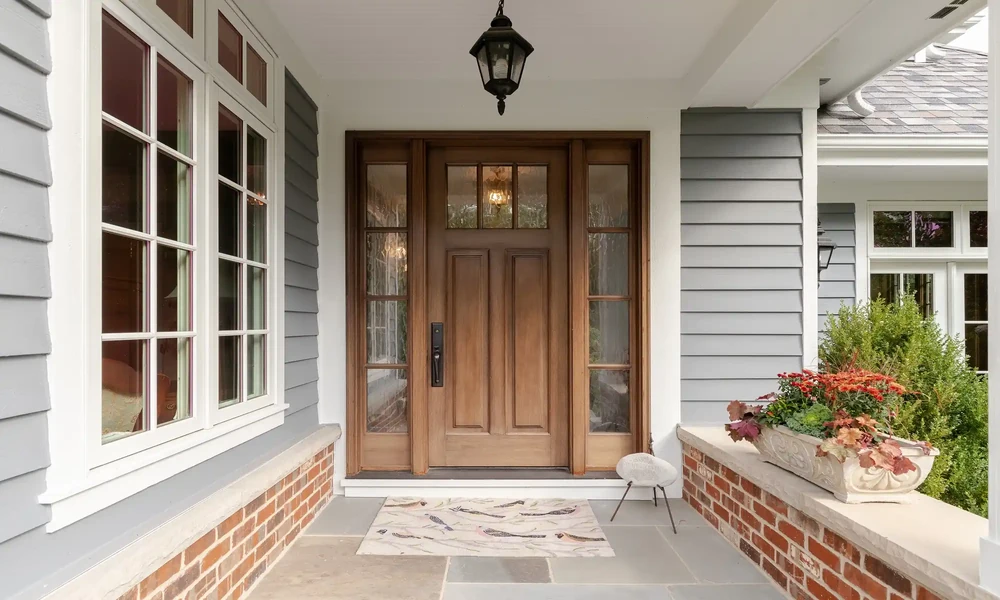
Your front door gets judged in about three seconds. That’s all a visitor, a buyer’s agent, or a curious neighbor needs to form an opinion about the entire property. Not the landscaping, not the paint color, not the roof. The door. So if you’re treating it as an afterthought, you’re leaving real money and real impressions on the table.
The decisions you make about that door – material, finish, glass type, hardware – compound each other in ways most homeowners don’t fully appreciate until they see two nearly identical homes side by side. One door stops traffic. The other blends into the drywall. This piece breaks down exactly how each layer of that decision works and why the details matter far more than the headline number on the price tag.
The Numbers Behind the Door
Before getting into the design specifics, it helps to understand why your door choice is one of the highest-leverage exterior investments you can make. Nine out of the top ten remodeling projects with the highest return on investment were exterior improvements, according to the 2024 Cost vs. Value Report – and exterior door replacement ranked second nationally, delivering an average ROI of 188%.
That figure isn’t a rounding error. A front door is one of the few home upgrades that can return more than you put in, largely because of what it signals. A well-chosen door tells buyers the home has been maintained, considered, and cared for. A worn, generic door tells them the opposite, even if everything inside is perfect.
Among REALTORS, 92% have suggested sellers improve curb appeal before listing, and 97% of NAR members believe curb appeal is important in attracting a buyer, according to the National Association of REALTORS’ 2023 Remodeling Impact Report: Outdoor Features. That’s not an opinion from a home-design blog. That’s the professional consensus of the people who actually sell homes for a living.
Introducing the Door Detail Hierarchy
Here’s a framework worth keeping in your back pocket when you’re making door decisions. Call it the Door Detail Hierarchy. It works from the outside in, matching the order in which the human eye actually processes a front entry:
- Material and silhouette – what the door says from fifty feet away
- Finish and color – what draws the eye from twenty feet
- Glass design – the texture and character that registers at ten feet
- Hardware and accessories – the details that seal the impression when you’re standing right at the threshold
Most homeowners think about level one and maybe level two. The ones who get it right think about all four as a single coordinated decision. When one level fights another – say, a bold matte-black iron silhouette paired with cheap brushed-nickel hardware – the whole composition falls apart. The door looks unfinished, even if it technically “works.”
The hierarchy also tells you where to put your money. If your budget is limited, you don’t split it equally across all four levels. You nail the silhouette first, then work your way down. A striking iron frame with a clean powder coat and modest glass will always beat an elaborate glass pattern stuck in a flimsy wood frame with peeling paint.
Material Dictates Everything That Follows
Iron has held its place in architectural history for a reason that goes beyond trend cycles. The journey of iron doors began with wrought iron featuring intricate scrollwork and elegant curves, and as architectural styles evolved, iron door designs incorporated innovations that combined aesthetic appeal with enhanced security. That combination – beauty and function working together rather than trading off – is what makes iron doors a fundamentally different proposition than wood or fiberglass.
Wood warps. Fiberglass mimics. Iron just is. If you live in a climate with extreme heat, like Arizona, that distinction matters even more. A door that looks beautiful in the showroom but buckles after two Phoenix summers isn’t a good deal at any price.
Beyond durability, material determines how much customization is actually possible. Iron accepts powder-coat finishes in a far wider range than wood accepts stain, and it holds them longer. You’re not repainting every three years. That long-term stability is part of what the Cost vs. Value data captures, even if the report doesn’t spell it out explicitly.
Finish and Glass: The Visual Conversation
Think about a homeowner in the Scottsdale area choosing between a standard pre-hung steel door in a flat black and a custom iron door with a hand-applied matte charcoal finish, rain-textured glass panels, and a coordinating wrought iron pull handle. The price difference is real. So is the difference in what each door communicates when a buyer pulls into the driveway for the first time.
The flat black says: “functional.” The custom iron says: “someone put thought into this house.” Buyers carry that feeling through the entire showing. It’s not rational; it’s just how perception works.
Glass choice adds another layer. Clear panels maximize light and create an open, airy feel – a good call for a home with a dramatic foyer worth showing off. Textured options like rain, frost, or water-cubic glass soften the entry, add privacy, and create visual interest without reducing natural light dramatically. The choice should respond to your architecture, not just your personal taste. A Mediterranean-style home almost always looks better with decorative textured glass than with a plain clear panel, no matter how clean and modern that panel might feel in isolation.
Hardware and Accessories: Where the Entry Earns Its Character
This is the level most people underinvest in, and it shows. A handle set that rattles, a deadbolt that doesn’t match the hinge finish, or a knocker that looks like it came from a big-box clearance bin – each of these is a small detail that quietly erodes confidence in everything around it.
Investing in quality iron door accessories is the step that transforms a good entry into a great one. The pull handle, the lock set, the decorative clavos if your style calls for them – these elements function as the punctuation at the end of your door’s design statement. Get the sentence right, then punctuate it properly.
Finish consistency is the single most important rule at this level. If your door wears a matte black powder coat, your hardware should follow – not in a matching-set, catalog way, but in a way that keeps the eye moving smoothly rather than stopping on a mismatched element. Warm bronze hardware against a cool charcoal door, for example, can work beautifully if the proportions are right. Oil-rubbed bronze against a warm antique finish on the iron itself tends to feel cohesive in a way that brushed nickel almost never does with darker finishes.
A Practical Decision Checklist Before You Buy
Before you finalize any door, run through these five checkpoints:
- Does the door’s silhouette match your home’s roofline and architectural style, not just its color palette?
- Have you selected the glass type based on your entry’s light needs and privacy requirements, not just aesthetics?
- Are all hardware finishes from a single family – matte, satin, or gloss – rather than a mix of surface treatments?
- Does the door work with or against your exterior paint or stone? Contrast can be powerful, but it needs to be intentional.
- Have you accounted for your climate? In high-UV, high-heat regions, powder-coat durability and glass thermal performance matter as much as looks.
The Long View on First Impressions
A front door isn’t just a feature you show buyers. It’s the thing you look at every single day when you come home. Research shows that homes with strong curb appeal, including a well-maintained exterior and inviting entryway, sell for an average of 7% more than comparable homes in the same neighborhood, according to a study published by Phys.org in August 2025. That 7% doesn’t come from one dramatic renovation. It comes from the accumulation of considered choices, from the material you chose to the pull handle you selected on the last pass through the showroom.
Your front door is the first thing people see and the last thing they remember. Give it the attention it deserves, and it will return the favor every time someone pulls up to your home for the first time.
| Door Detail Level | What It Communicates | Visible Distance | Common Mistake |
|---|---|---|---|
| Material & Silhouette | Durability, architectural fit | 50+ feet | Choosing style over climate suitability |
| Finish & Color | Intentionality, maintenance | ~20 feet | Trendy color that clashes with exterior stone |
| Glass Design | Character, privacy balance | ~10 feet | Plain clear glass on a detailed iron frame |
| Hardware & Accessories | Quality, care, completion | Arm’s length | Mixed finishes from different metal families |
“Everybody intuitively knows curb appeal matters, but nobody had quantified it. When you can point to a number, it helps both buyers and sellers understand the trade-offs. A well-kept exterior signals that the inside has been cared for too.”
– Dr. Sriram Villupuram, researcher whose findings on curb appeal premiums were reported by Phys.org, August 2025
